FullBrowser
FullBrowser instance module.
The original implementation of the browser was inspired by Globot and WebVoyager. Thanks to them.
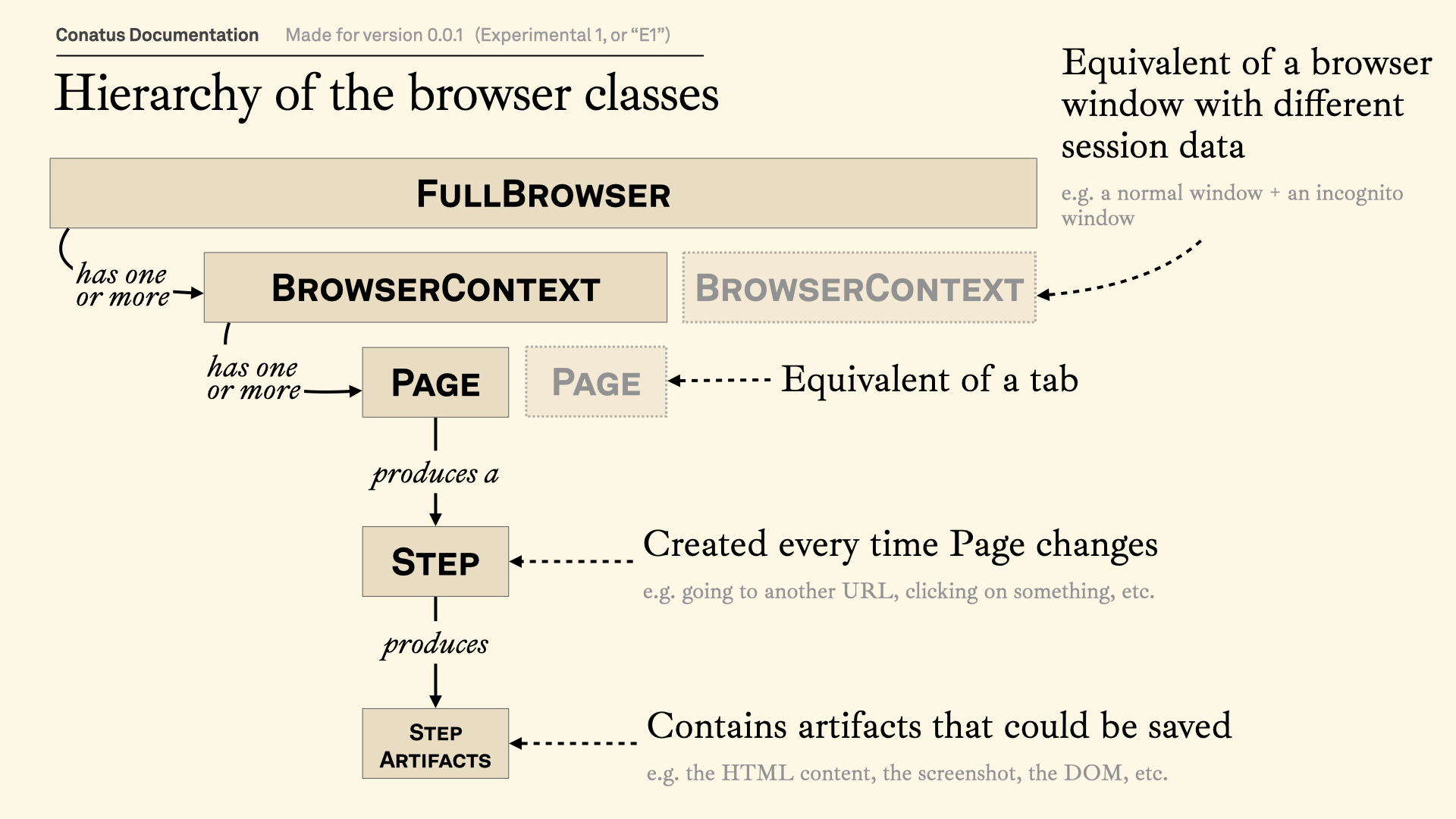
Mapping the Playwright hierarchy to the Conatus browser classes
A FullBrowser module is
essentially a wrapper around Playwright. To understand how
FullBrowser works, it is
essential to do a little primer on the architecture of Playwright, and
especially the hierarchy of its abstractions:
Playwright instance
A Playwright instance controls one or multiple browser instances. Playwright can launch a Chrome browser, a Webkit browser, and a second Chromium browser, if it so wishes.
The equivalent of the Playwright instance in Conatus is the
FullBrowser class.
Warning
Unlike Playwright, Conatus does not support multiple browser instances.
Browser instance
A Playwright browser instance controls one or multiple browser contexts. Think of it as having one normal Chrome window, and one incognito Chrome window.
The Conatus equivalent of a Playwright browser instance is still the
FullBrowser class.
Browser context
A Playwright browser context controls one or multiple pages. Think of a page as one tab in the browser.
The Conatus equivalent of a Playwright browser context is
BrowserContext
class, which encapsulates the Playwright BrowserContext, and adds some
extra functionality.
Page
A Playwright page is the lowest level of abstraction in Playwright.
We keep track of each page in the Page class, which encapsulates the
Playwright Page, and adds some extra functionality.
Step
We implement one additional class: Step. We think of every time a page
changes as a step. This class keeps track of static information at every load,
such as screenshots, the HTML data, etc.
A related class is StepArtifacts, which
keeps track of the various saveable artifacts related to a page.
You might not need to use the FullBrowser class
This might sound like a lot. In fact, most of the time, you will only want to
use the SimpleBrowser class, which
provides a simpler interface to the browser (albeit with a few constraints).
FullBrowser(
    *,
    headless: bool = DEFAULT_HEADLESS,
    writer: FileWriter | None = None,
    config: BrowserConfig | None = None,
    async_init: bool = False
)
Wrapper around Playwright with full browser capabilities.
Init in sync or async context
You can initialize a FullBrowser instance in a synchronous or asynchronous
contexts:
from conatus.utils.browser.full import FullBrowser

# Synchronous context
browser = FullBrowser(headless=True)

# Async context
# browser = await FullBrowser.init_async(headless=True)
| PARAMETER | DESCRIPTION |
|---|---|
headless
|
Whether to run the browser in headless mode. Defaults to True.
TYPE:
|
writer
|
The file writer that handles writing logs and outputs. If you pass a writer, it will override the writer in the config.
TYPE:
|
config
|
The BrowserContext and
Page for the
available options. Defaults to {}.
TYPE:
|
async_init
|
Whether to initialize the browser asynchronously. The user should not set this parameter. Defaults to False.
TYPE:
|
Source code in conatus/utils/browser/full.py
instance-attribute

The Playwright browser instance.
Not to be confused with the Playwright instance, which is self.pw.
instance-attribute

headless: bool = headless
Whether to run the browser in headless mode. Defaults to True.
instance-attribute

pw: Playwright = (
    run_async(get_or_create_playwright_instance())
    if PLAYWRIGHT_INSTANCE is None
    else PLAYWRIGHT_INSTANCE
)
The Playwright instance.
Not to be confused with the Playwright browser instance, which is
self.instance. In practice, pw will not control multiple browsers;
we keep the two attributes separate because Playwright has APIs that
depend on one or the other.
instance-attribute

config: BrowserConfig = (
    BrowserConfig() if config is None else config
)
The configuration of the browser.
property

current_context: BrowserContext
Get the current context.
We define current context as the last context in the list of contexts.
| RETURNS | DESCRIPTION |
|---|---|
BrowserContext
|
The current context. |
property

current_page: Page
Get the current page.
We define current page as the last page in the last context.
| RETURNS | DESCRIPTION |
|---|---|
Page
|
The current page. |
property

current_step: Step
Get the current step.
We define it as the last step in the last page in the last context.
| RETURNS | DESCRIPTION |
|---|---|
Step
|
The current step. |
async
classmethod

init_async(
    *,
    headless: bool = DEFAULT_HEADLESS,
    writer: FileWriter | None = None,
    config: BrowserConfig | None = None
) -> FullBrowser
Create a FullBrowser instance in an async context.
| PARAMETER | DESCRIPTION |
|---|---|
headless
|
Whether to run the browser in headless mode. Defaults to True.
TYPE:
|
writer
|
The file writer that handles writing logs and outputs.
TYPE:
|
config
|
The
TYPE:
|
| RETURNS | DESCRIPTION |
|---|---|
FullBrowser
|
The FullBrowser instance. |
Source code in conatus/utils/browser/full.py
async

close_async(*, including_pw: bool = False) -> None
Close the browser in an async context.
| PARAMETER | DESCRIPTION |
|---|---|
including_pw
|
Whether to close the Playwright instance. Defaults to False. You should only close the Playwright instance if know what you are doing.
TYPE:
|
Source code in conatus/utils/browser/full.py
close(*, including_pw: bool = False) -> None
Close the browser.
| PARAMETER | DESCRIPTION |
|---|---|
including_pw
|
Whether to close the Playwright instance. Defaults to False. You should only close the Playwright instance if know what you are doing.
TYPE:
|
Source code in conatus/utils/browser/full.py
async

Ensure only one Playwright instance is shared across the session.
This is necessary because Playwright throws an error if you try to create multiple instances.
| RETURNS | DESCRIPTION |
|---|---|
Playwright
|
The Playwright instance. |